The Battle of Hastings that forever changed the destiny of England, its culture, and its language.
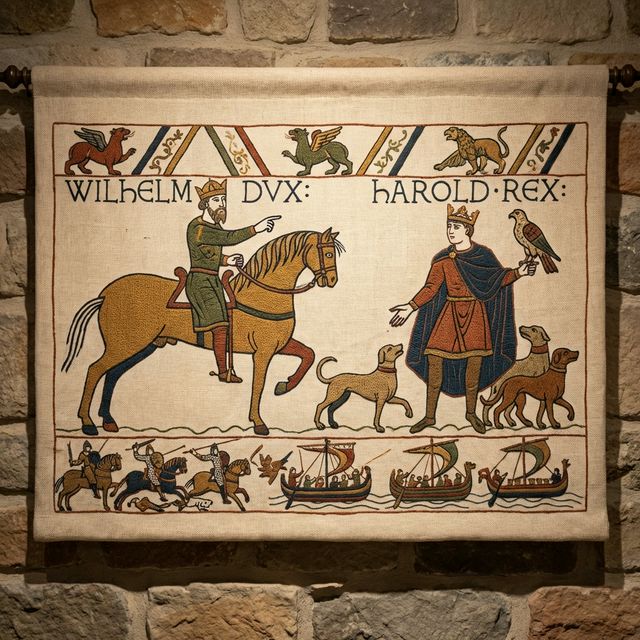
Begin ExplorationIn the autumn of 1066, William, Duke of Normandy, crossed the English Channel with his army. At the historic Battle of Hastings, he defeated the Anglo-Saxon King Harold Godwinson, bringing the Anglo-Saxon era to an end.
William the Conqueror was crowned in Westminster Abbey, introducing a new aristocracy, feudal laws, castle architecture, and his native culture to the British Isles.
Perhaps the most profound and lasting legacy of the conquest was its impact on language. The new elite spoke Old Norman French, while the common people spoke Old English.
Over centuries, these languages merged, enriching the English vocabulary. The most famous example of this class-based linguistic divide lies in the names of animals. While an animal was raised by an Anglo-Saxon peasant (Cow, Pig), it retained its Germanic name. But when served at the table of a Norman lord (Beef, Pork), it acquired a French name.